
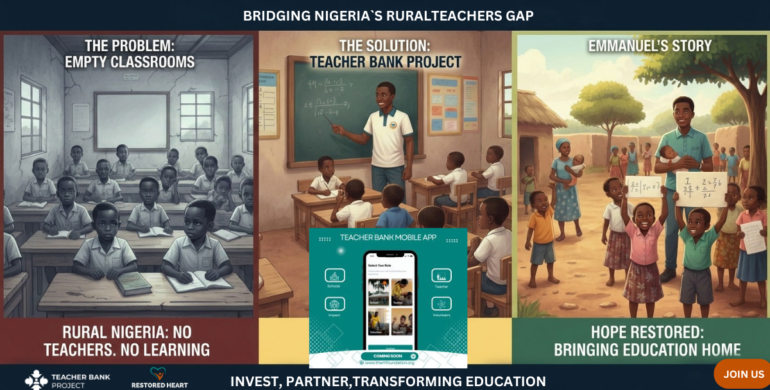
The classroom has forty children in it, and they arrived at 7:30 am, which is quite normal for them. Some walked for forty minutes with food in their stomach and some others with no food. They arranged themselves in rows, opened their notebooks and waited.
The teacher did not come.
Not because she was late or because there was an emergency, but because there was no teacher and there haven’t been any in the last three months. The school’s only qualified mathematics teacher had relocated the previous term, chasing better pay, better infrastructure, better everything and no replacement had arrived. The government posting list said one was coming; It had been saying that for months.
The Children got into their classrooms. Some talked quietly, others took out their notebooks, while older ones tried to teach the younger ones what they could remember from last term’s lessons. The morning passed the way too many mornings do in most rural Nigerian schools, full of children who showed up ready to learn and empty of the person who was supposed to teach them.
This classroom is not in a remote corner of the country that nobody has heard of; it is in a community within the Federal Capital Territory (FCT). A community with a school building, with benches, a blackboard, and children whose parents made sure they got dressed and showed up every single day. The parents understood with startling clarity that education was the only ladder their children had, but the ladder was missing a rung, and nobody was coming to fix it.
“Forty children showed up ready to learn. The teacher did not come. This is not a story about one classroom. It is a story about hundreds.”
The Teacher Shortage Nobody Is Talking About
Nigeria has a teacher shortage; this is not a secret. Education researchers, civil society organisations, and government reports have been documenting it for years, but the way it is usually discussed in aggregate numbers, in policy papers, and in budget debates tends to obscure the most important thing about it.
The shortage is not evenly distributed; it is concentrated, with brutal precision, in the places least equipped to absorb it.
Urban schools in Nigeria face real challenges, but they have options; they have pools of qualified teachers nearby, they have competitive salaries that attract applicants, and proximity to universities producing new graduates, such that when a teacher leaves, another one can usually be found.
Rural schools have none of this. When a teacher leaves a rural school, they leave a gap that can take years to fill if it gets filled at all. The qualified teachers who might replace them do not want to move to communities with no reliable electricity, no internet connection, no secondary school for their own children, no career development opportunities, and so the gap remains.
In some rural communities across the FCT, schools have been operating with fewer than half the teachers they are supposed to have. Classes are merged, subjects disappear from the timetable, children in their final primary years go months without a mathematics lesson, without a science lesson, without any lesson at all in some subjects, because nobody is there to teach them.
The consequences follow these children for the rest of their lives. They sit for WAEC examinations underprepared, fail subjects they might have passed with proper instruction, some drop out, and give up on secondary school entirely. The cycle continues, rural communities producing fewer qualified adults, which means fewer teachers willing to return, which means fewer children receiving the education that might break the cycle.
“The shortage is not evenly distributed. It is concentrated, with brutal precision, in the places least equipped to absorb it.”
The Teacher Bank Project: A Different Kind of Solution
The Restored Heart Foundation’s Teacher Bank Project begins from a simple observation: there are qualified teachers in Nigeria who are unemployed, underemployed, or working in fields outside education, not because they do not want to teach, but because the system has not connected them to the schools that need them most.
TBP is built to make that connection.
At its core, the Teacher Bank Project maintains a verified bank of qualified, committed teachers screened for qualifications, interviewed for suitability, and ready to be deployed to rural schools facing critical shortages. When a school has a vacancy, the TBP, through the TBP App, works to match the right teacher to the right school, taking into account subject expertise, community needs, and deployment logistics. TBP is not just a matching service; it is a support system.
Teachers deployed through TBP do not arrive in rural communities and disappear; they are supported before, during, and after deployment with orientation, with community integration support, with a network of fellow TBP teachers who understand the particular challenges and rewards of teaching in rural Nigeria.
And critically, TBP has built a dedicated mobile application, the TBP App, that makes the entire process faster, more transparent, and more scalable, where teachers can register their availability and subject expertise. The app facilitates the match, tracks the deployment, and keeps both school and teacher connected to TBP’s support network throughout.
For the children in that classroom, we described at the beginning the forty who arrived at 7:30 am with their notebooks open and their teacher absent, TBP represents a real and practical answer. Not a policy proposal. Not a committee recommendation, but a teacher in the classroom.
“There are qualified teachers in Nigeria who are ready to teach. And there are classrooms full of children who are ready to learn. TBP exists to bring them together.”
Emmanuel's Story
Emmanuel is twenty-six years old. He graduated from a teacher training college in 2023 with a degree in mathematics education and a genuine desire to teach. He applied for government postings to no avail until he decided to work at a private school in Abuja for below minimum wage, teaching four different subjects to classes he was not trained for, while he waited for a posting that never came.
By the time TBP found Emmanuel, or rather, by the time Emmanuel found TBP through a contact at his former colleague, he had begun to wonder if teaching was actually in his future at all.
TBP matched Emmanuel with a rural secondary school in the FCT that had been without a mathematics teacher for two terms. The school had 180 students, and not one of them had received a proper mathematics lesson in six months.
Emmanuel has now been deployed at that school for several months, where he teaches four mathematics classes a day, and he runs an after-school session twice a week for students who are catching up on what they missed. He has become, by all accounts, exactly the kind of teacher rural Nigeria needs: committed, present, and deeply invested in the community he now calls home.
He will tell you that it is not easy, as rural deployment comes with real challenges, infrastructure gaps, resource shortages, and distances that make certain things harder. But he will also tell you something that surprises people who have not experienced it: that teaching in a community that genuinely needs you, and knows it needs you, is one of the most meaningful things a person can do.
“In Abuja,” he said, “I was invisible. Here, I matter. The children know my name, their parents know my name, I walk to school every morning, and I know that those forty children are going to learn something today that they did not know yesterday. That is enough.”
“I walk to school every morning knowing those forty children are going to learn something today that they did not know yesterday. That is enough.” — Emmanuel
What We Are Building and Why It Matters to You
The Teacher Bank Project is still young, but what it has already demonstrated is that the problem of rural teacher shortages is not unsolvable; it is logistical, it is a matching problem, a support problem, a connection problem, and those are problems that a well-designed intervention can address.
At the beginning of the 2025/2026 academic session, we had a baseline of six hundred and eighteen (618) across our implementing schools and by the end of the first term, we had reached one thousand one hundred and five (1,105) students.
What TBP needs to grow to reach more schools, deploy more teachers, and build the App into the powerful platform it has the potential to become is an investment. Not an investment in a model that is already working, in communities that are already feeling the difference, in children who are already sitting in classrooms where a teacher now shows up every morning.
If you are an education funder, a corporate CSR partner, or an organisation committed to closing the education gap in Nigeria, we want to show you what TBP looks like on the ground. We want to take you to Emmanuel’s classroom and let you watch forty children learn mathematics from a teacher who is exactly where he is supposed to be.
Because the classroom we opened this post with, the one with forty children and no teacher, does not have to stay that way. The teacher exists, and the children are there. TBP is the bridge between them.
Help us build that bridge further.
