
- RHF Editorial
- Leave a Comment on To Every Woman in a Rural Community: A Letter at the End of Women’s Month
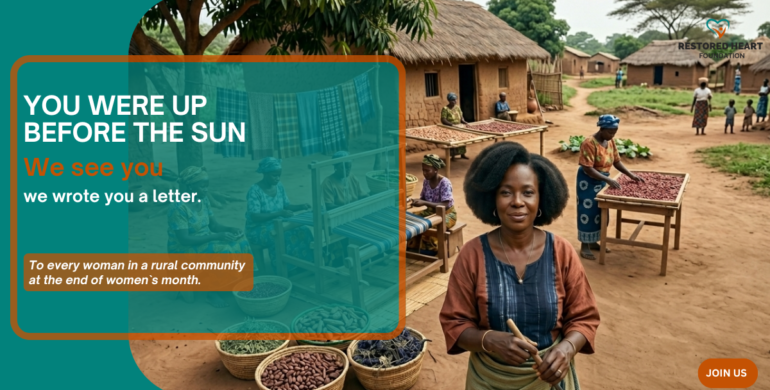
You were up before the sun, and you made sure the children ate before you thought about eating yourself. You carried water, carried worry, carried the quiet weight of everything that still needed doing, and you did it without asking anyone to notice.
You have dreams that you have not spoken aloud in years, not because they stopped mattering, but because the distance between where you are and where those dreams live feels too wide to say out loud.
We see you; we have been sitting in your community, walking your roads, listening to your stories, and this letter, at the end of a month the world spent celebrating women, is for you.
“We see you; we have been sitting in your community, walking your roads, listening to your stories.”
What Women's Month Looks Like From Here
International Women’s Day arrives every March 8 with speeches, graphics and celebrations of women who broke glass ceilings. It is not that those stories do not matter, but they are very far from the life of a woman in a rural community who is navigating a high-risk pregnancy without a clinic nearby.
Women’s Month, from where RHF sits, does not look like a conference rather, it looks like a community health worker leaving her house to check on a pregnant woman who missed her last visit, it looks like a mental health first aider sitting with a woman who has never had the language to describe what she has been carrying, and it looks like a girl who stayed in school because someone made it possible for her to stay.
That is not the Women’s Month that makes headlines, but it is the one that changes lives.
“Women’s Month, from where RHF sits, does not look like a conference. “
Three Women We Have Been Thinking About
We are not going to use their real names, but we want to tell you about three women whose stories have stayed with us this month.
The mother who kept going
She was told her pregnancy was high-risk, and the nearest clinic was two hours away, but she walked it, every single visit, because she did not know there was another option. When MCHI’s community health worker knocked on her door for the first time, she said she thought she was coming to tell her something was wrong. She did not know that someone could come just to check and be there for her, making sure she was not carrying this alone.
The woman who learned the word for what she felt
She had been feeling it for years; the heaviness, the withdrawal, the days when getting up felt impossible. She had no word for it because in her community, there was no framework for it. When MHFF’s mental health first aid training reached her community, and she sat in that room for the first time, she heard someone describe exactly what she had been living with. She cried not from sadness but from recognition, from the relief of being seen.
The girl who is still in school
She almost did not make it to this school year because her family was struggling. The cost of keeping her in school felt impossible, and calculations were already being made about who stays and who goes. She stayed not because the system made it easy, but because someone intervened. She is sitting in a classroom right now
“She heard someone describe exactly what she had been living with. She cried not from sadness but from recognition.”
What We Believe About Women's Empowerment
Empowerment is a word that gets used a lot in the development sector, and we have become careful about how we use it. What we have seen in the years of working in rural communities that the women we serve do not need to be empowered by outsiders because they are already extraordinary, resilient, resourceful, and clear-eyed about what their communities need.
What they need is access; access to healthcare that reaches them where they are, access to mental health support that takes their invisible pain seriously and access to education systems that do not make their daughters choose between learning and surviving.
That is what RHF is building, not empowerment from the outside in but access from the ground up.
“The women we serve do not need to be empowered by outsiders. They are already extraordinary. What they need is access”
What We Want Women's Month to Demand of All of Us
It is easy to celebrate women for one month and change nothing for the other eleven, it is easy to post a graphic on March 8 and go back to underfunding community health programs on March 9, and it is easy to talk about gender equality at a conference and then return to a funding model that consistently overlooks the organisations working at the community level, the level where gender inequality is actually lived.
So here is what we want Women’s Month to demand of funders, of partners, of everyone who consumed Women’s Day content this March and felt moved by it:
The woman in rural Nigeria who walked two hours to a clinic does not need to be celebrated; she needs the walk to be shorter, the community health worker to already be there and she needs the system to have been designed with her in mind from the beginning.
That is the work, and it does not end on March 31.
“The woman in rural Nigeria does not need to be celebrated. She needs the walk to be shorter.”
To Every Woman We Serve: A Final Word
This letter started with you, and it ends with you. You did not ask for this month to be about you; you probably did not have time to notice it was because you were busy with the children, with the work, with the quiet persistence of a life that asks everything of you every single day. We want you to know that what you carry is not invisible to us, but we see the early mornings and the late nights; we see the dreams you have put on hold and the ones you are still holding onto.
We are going to keep showing up for you, not just in March, not just on International Women’s Day, but every month, in every community we can reach, for as long as it takes. Because you deserve more than a month. You deserve a system that was built with you in mind.
We are trying to build it.
If this post moved you, share it.
If you are a funder or partner who wants to invest in women’s health, education, and empowerment at the community level in rural Nigeria, we would love to talk.
