
What would you do if the nearest clinic was two hours away and you were nine months pregnant?
Not two hours by car but two hours on foot through uneven terrain, in the harmattan heat, with a body carrying the full weight of a pregnancy that no one had properly monitored. With no community health worker in your village, no antenatal record, and no one who would come to you if something went wrong at night.
This is not hypothetical. This is the reality that Amina faced.
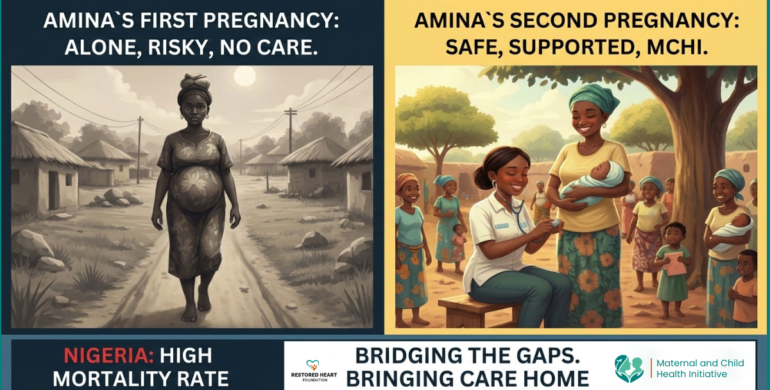
Amina is twenty-three years old and lives in a small rural community in Nigeria, close enough to a megacity that you might assume she has access to basic healthcare. During her first pregnancy, she had heard of antenatal visits, but she had never been to one.
When we met Amina through the Maternal and Child Health Initiative (MCHI), she was in her second pregnancy. Frightened, unsure, and carrying the memory of a first delivery that had gone badly, a delivery she had managed almost entirely alone, supported only by an elderly neighbour who had been delivering babies by instinct and prayer for thirty years.
She survived, and her baby survived, but it was close, and she knew it was.
“I did not know there was help available. I thought this was just how it was for people like us.”
The Crisis Nobody Talks About Loudly Enough
According to the World Health Organization (WHO), Nigeria has one of the highest child mortality rates in the world and accounts for nearly one in five of all maternal deaths globally; a statistic so large that it is easy for the mind to slide past it without pausing.
Behind the statistics is a pattern that is entirely predictable and entirely preventable. The women who die are women who could not access care, not because they did not want it, but because the system was never built to reach them. They live in communities where there is no primary healthcare center within walking distance, or there is one, but it has no midwife. In some cases, there could be a midwife but no supplies, or there could be supplies that are not affordable to them. Worse of all, she simply did not know she was entitled to care at all.
The reasons stack up, and at the bottom of every stack is a woman like Amina who is invisible to the system, managing the most vulnerable moment of her life with whatever she could find.
This is the gap the Restored Heart Foundation’s Maternal and Child Health Initiative (MCHI) exists to close.
“The women who die are not dying because medicine cannot save them. They are dying because medicine never reached them”
What MCHI Actually Does and Why It Matters
The Maternal and Child Health Initiative does not wait for women to come to the system; rather It brings the system to them.
MCHI works by embedding trained community health workers directly inside rural communities, people who know the village, speak the language, and have earned the trust of the women they serve. These are not outsiders arriving with clipboards; they are neighbours, they are the women who know your name, know your due date, and will knock on your door when you have not been seen in a week.
Through MCHI, pregnant women in participating communities receive proper antenatal care, health monitoring, nutritional guidance, danger sign education, and safe delivery planning, often for the first time in their lives. Infants receive early childhood health support that tracks their development and catches problems before they become crises.
And perhaps most importantly: women learn that they are entitled to this care and that access to a safe pregnancy is not a privilege. It is a right.
For Amina, MCHI meant that her second pregnancy looked nothing like her first. She had a community health worker visiting her regularly, she had an antenatal record, she had a birth plan, and she had someone to call when the contractions started, but she was not sure what was happening.
She delivered safely, and her daughter, a healthy girl she named Hauwa, was born with a birth attendant present, in a clean environment, and with the right support in the room.
It sounds simple. Actually, it should be simple, but for millions of Nigerian women, it is anything but that.
“When the health worker came to my house the first time, I cried. Nobody had ever come to check on me before.” – Amina
The Walk She Should Never Have Had to Take
We want to return to the walk, the two-hour walk. Because here is what we want you to understand: Amina walked two hours to a clinic during her first pregnancy, not because she was uninformed, or careless, or unaware of risk. She walked because she loved her unborn child enough to do whatever it took, even when the system offered her almost nothing to work with.
That kind of love, fierce, exhausting, and uncomplaining, exists in rural communities across Nigeria. In the community we have entered through MCHI, we have found women doing extraordinary things just to access ordinary care, like walking for hours, borrowing money that they do not have and waiting months for appointments that may or may not come.
They are not passive, not giving up, but they are simply being failed by infrastructure that was never built for them, by a health system designed around urban centers, by policies that have not caught up with the reality of who needs care most and where those people actually live.
MCHI might not be able fix the entire system, but it can change the reality for the communities it serves, one family at a time, one birth at a time, one health worker visit at a time.
And it can insist, loudly and consistently, that the walk Amina took should not be normal, should not be acceptable, should not be the price any woman has to pay to bring a child safely into the world.
“Every safe delivery is a small act of justice. And justice, repeated enough times, becomes change.”
What This Means and What You Can Do
Stories like Amina’s are not rare; they are the norm for hundreds of thousands of women in rural Nigeria right now, this week, as you read this.
The Restored Heart Foundation built MCHI because we believe that where a woman lives should not determine whether she survives her pregnancy; geography is not destiny. A two-hour walk to a clinic is not an unfortunate fact of life; it is a solvable problem.
But solving it requires resources, it requires trained community health workers who can be deployed and sustained, it requires health supplies that can reach the communities that need them, and it requires partnerships with organizations and funders who understand that the most important investments are often the ones made farthest from the spotlight.
If you are a funder, a partner, or an organisation working in the health and development space, we want to talk to you. Not to pitch you a program but to show you what is already working, and to explore how we can make it reach further.
Because Amina’s daughter, Hauwa, is healthy today, and we want every child born in rural Nigeria to have the same chance at a healthy beginning.
That is what MCHI is working toward, and that is what your partnership can help make real.
